
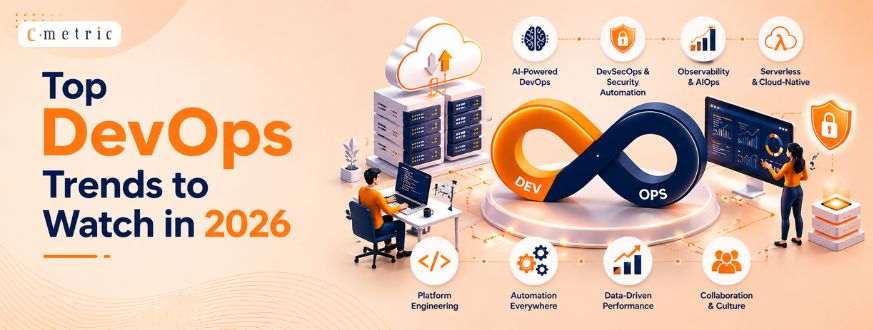
Top DevOps Trends to Watch in 2026
The way software is built, tested, and deployed has been fundamentally reimagined and in 2026, DevOps sits at the center of that transformation. As businesses face mounting pressure to ship faster, reduce downtime, and scale with confidence, the latest DevOps trends are shaping how engineering teams operate, collaborate, and innovate. From AI-driven automation to the rise of security-first pipelines, DevOps trends are no longer just an IT conversation, they are a strategic business imperative. In this blog, we cover what DevOps means today, why it matters more than ever in 2026, the top trends redefining the discipline, and what lies ahead for organizations embracing a DevOps-first culture.
What is DevOps? Understanding the Basics
If you have been asking what is DevOps or searching for the DevOps definition, here is a clear answer: DevOps is a cultural and technical movement that bridges the gap between software development (Dev) and IT operations (Ops). Rather than treating these two functions as separate silos, DevOps integrates them into a single, collaborative workflow with automation, continuous feedback, and shared accountability at its core.
Understanding the dev ops meaning goes beyond tools and pipelines. It represents a mindset shift, one where development teams and operations teams work together from the very beginning of a project to ensure code is built, tested, and deployed reliably and rapidly. The result is faster release cycles, fewer production incidents, lower operational costs, and a far better experience for end users. In 2026, the DevOps trends driving the industry forward are built on this foundational philosophy.
Why DevOps is Crucial in 2026
The pace of digital change has not slowed, it has accelerated. Keeping up with DevOps trends 2026 is essential for any organization that wants to remain competitive, resilient, and capable of meeting customer expectations. Here is why DevOps has become non-negotiable:
Faster Software Delivery
Continuous integration and continuous deployment (CI/CD) pipelines allow teams to push code updates multiple times per day with automated testing ensuring quality at every step. In a market where speed is a competitive advantage, DevOps dramatically reduces time-to-market and lets businesses respond to user feedback in near real time.
Improved Collaboration
One of the most impactful outcomes of DevOps adoption is the breakdown of organizational silos. When development and operations teams share goals, tools, and responsibilities, communication improves significantly. Agile workflows, shared dashboards, and cross-functional accountability lead to faster problem resolution and fewer misalignments between what is built and what is deployed.
Enhanced System Reliability
Modern DevOps trends place a strong emphasis on observability and automated monitoring. By instrumenting applications with real-time alerting, log aggregation, and performance tracing, teams can detect and resolve issues before they impact users by reducing downtime, improving system stability, and building greater trust in the software delivery process
Top DevOps Trends to Watch in 2026
The DevOps trends 2026 landscape is evolving rapidly, shaped by advances in artificial intelligence, the growing sophistication of cyber threats, and the continued maturation of cloud-native infrastructure. Here are the four trends every engineering leader needs to understand:
AI and Machine Learning Integration
AI is no longer just a feature of the products teams build, it is increasingly embedded in the DevOps toolchain itself. AI-driven automation is accelerating code reviews, optimizing build pipelines, and enabling predictive analytics that flag potential failures before they occur. Machine learning models analyze historical deployment data to recommend rollback strategies, identify performance regressions, and even auto-remediate common infrastructure issues. This trend often called AIOps, it is one of the most transformative DevOps trends redefining how modern teams operate.
Rise of DevSecOps
Security can no longer be a post-deployment afterthought. DevSecOps integrates security checks, vulnerability scanning, and compliance validation directly into CI/CD pipelines by making security a shared responsibility from day one. As regulatory requirements tighten globally and attack surfaces grow with cloud adoption, the shift from DevOps to DevSecOps is one of the most critical DevOps trends organizations must priorities in 2026.
Infrastructure as Code (IaC)
Infrastructure as Code is the practice of managing and provisioning computing infrastructure through machine-readable configuration files rather than manual processes. Tools like Terraform, Pulumi, and AWS Cloud Formation allow teams to version-control their infrastructure just as they do their application code by enabling consistency, repeatability, and rapid scaling across environments. IaC eliminates configuration drift, reduces human error, and makes disaster recovery dramatically more straightforward.
Kubernetes and Containerization Growth
Container-based deployment, orchestrated by Kubernetes, has become the dominant paradigm for modern application infrastructure. Containers package applications and their dependencies into portable, consistent units that run identically across development, staging, and production environments. Kubernetes automates the deployment, scaling, and management of these containers, giving teams the resource efficiency and resilience required for high-traffic, globally distributed applications. Kubernetes adoption continues to accelerate as a defining feature of the 2026 cloud-native landscape.
DevOps Tools Powering Modern Development
A strong grasp of what is DevOps in practice requires familiarity with the tools that make it work. The dev ops meaning comes to life through a carefully chosen toolchain that automates, monitors, and accelerates every stage of the software delivery lifecycle. The most widely adopted tools shaping DevOps trends in 2026 include:
- Jenkins & GitHub Actions: The backbone of CI/CD pipelines-automating build, test, and deployment workflows with every code commit.
- Docker: The industry-standard containerization platform, enabling consistent application packaging across environments.
- Kubernetes: The leading container orchestration system for managing large-scale, distributed application deployments.
- Terraform: The most widely used Infrastructure as Code tool, enabling teams to provision and manage cloud resources through declarative configuration files.
- Prometheus & Grafana: The go-to stack for real-time monitoring, metrics collection, and visualization in cloud-native environments.
Cloud platforms particularly AWS, Microsoft Azure, and Google Cloud provide the underlying compute, networking, and managed services on which these tools run. Explore C-Metric’s DevOps Services and Solutions to see how we help businesses build and optimize modern DevOps toolchains.
Benefits of Following DevOps Trends for Businesses
Staying current with DevOps trends is not just about technical advancement, it translates directly into measurable business outcomes:
- Faster Delivery: Automated pipelines and CI/CD practices dramatically reduce the time between writing code and shipping features to customers.
- Improved Collaboration: Shared tools, shared metrics, and shared goals break down silos between development, operations, and security teams.
- Higher Reliability: Automated testing, monitoring, and incident response mean fewer outages and faster recovery when issues do occur.
- Cost Savings: Automation eliminates repetitive manual tasks, reduces infrastructure waste, and lowers the cost of production incidents.
- Better Customer Experience: Faster releases, fewer bugs, and higher system availability translate directly into greater customer satisfaction and retention.
Challenges in Adopting DevOps Trends
While the benefits are compelling, adopting the latest DevOps trends is not without its challenges. Organizations that underestimate these hurdles often struggle to see the returns they expect:
- Resistance to Change: Established organizations with traditional IT structures may face cultural pushback when shifting to collaborative, cross-functional DevOps ways of working.
- Skill Gaps: The DevOps toolchain is broad and evolving rapidly. Finding and retaining engineers with expertise across CI/CD, IaC, containerization, and cloud platforms remains a significant challenge.
- Implementation Complexity: Integrating DevOps practices into legacy systems and existing workflows requires careful planning, phased rollout, and often significant re-architecture.
- Security Concerns: Without a deliberate DevSecOps strategy, moving fast can inadvertently introduce security vulnerabilities by making it critical to embed security from the start rather than bolt it on later.
For organizations navigating these challenges, our deep dive on GenAI in DevOps explores how AI is helping teams overcome complexity and accelerate adoption.
Future of DevOps Trends in 2026 and Beyond
The evolution of DevOps trends shows no signs of slowing. Looking ahead, several forces will shape the next chapter of how software is built and delivered:
AI-driven DevOps will become the norm rather than the exception. As AIOps platforms mature, more of the routine work of pipeline management, incident triage, and capacity planning will be handled autonomously freeing engineers to focus on higher-value problem-solving. Organizations that invest in AI-augmented DevOps toolchains today will have a significant productivity advantage as the technology matures.
Cloud-native application development will continue its upward trajectory, with serverless architectures, edge computing, and multi-cloud strategies adding new layers of complexity and opportunity to the DevOps trends landscape. The emphasis on scalability, automation, and developer experience will only intensify, with platform engineering emerging as a dedicated discipline within larger organizations.
Perhaps most significantly, DevOps will cease to be the domain of technology companies alone. As digital transformation accelerates across financial services, healthcare, retail, and manufacturing, DevOps practices and DevOps trends will become standard operating procedure across every industry. Businesses that build this capability now will be far better positioned to adapt, innovate, and lead as the pace of change continues to accelerate.
Conclusion
The latest DevOps trends are not just reshaping how software teams work, they are redefining what it means to be a competitive, resilient business in 2026. From AI-powered automation and DevSecOps to Kubernetes and Infrastructure as Code, the organizations that embrace these trends will deliver better products faster, with greater reliability and security than those that do not.
Staying ahead in this environment requires continuous learning, the right tooling, and a culture that values collaboration and experimentation. The good news is that you do not have to navigate it alone.
Want to implement DevOps in your business? Connect with C-Metric’s expert team today and let us help you build a DevOps practice that drives real results.