
Why Your AI Doesn’t Know What It Doesn’t Know — And How RAG Fixes That
1. What Is RAG and What Problem Does It Solve?
Large language models are trained once on a massive dataset and then deployed. After training concludes, their knowledge is permanently fixed—a snapshot of everything in that dataset at that point in time. Ask such a model about an event that happened after its training cutoff, about your company’s internal policies, or about a research paper published last month—and it will either guess, confabulate, or politely decline.
This is not a bug in the model’s architecture; it is an inherent property of how these systems are built. The model’s knowledge lives entirely inside its parameters, and parameters do not update during deployment.
“A language model without retrieval is like an expert who reads everything once, then answers questions purely from memory—never allowed to look anything up.”
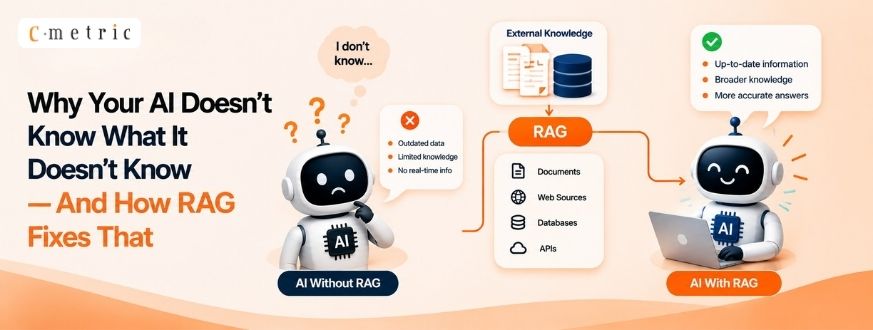
Retrieval-Augmented Generation (RAG) is the practical solution. Rather than asking the model to remember everything, RAG gives the model a reference library it can consult at the moment a question is asked. The relevant pages of that library are retrieved automatically, handed to the model as context, and the model generates an answer grounded in what it just read — not in what it learned months ago during training. For organizations building knowledge-aware applications, experienced AI consulting and development can help connect LLMs with enterprise data, retrieval systems, and business workflows.
This unlocks four things that a standalone LLM cannot reliably deliver:
Freshness. The knowledge base can be updated continuously. New documents indexed today are immediately available for retrieval without touching the model.
Domain specificity. Internal documents, proprietary manuals, industry standards, and private data can form the knowledge base — none of which appear in public training corpora.
Verifiability. Every answer can be traced back to the specific document passage it came from. The source is retrievable and human-readable.
Reduced hallucination. The model is anchored to real, retrieved text rather than generating from memory. When the retrieved context does not contain an answer, the model can honestly say so.
2. How Language Models Store and Use Knowledge
To understand why RAG is necessary, it helps to understand how knowledge is stored inside a language model in the first place.
During training, a language model processes billions of sentences and adjusts its weight parameters to become better at predicting the next word. Over time, statistical patterns from the training data become encoded in those weights—not as explicit facts in a lookup table, but as distributed, implicit associations across billions of numerical values. This is called parametric memory.
Think of it this way: the model does not have a database entry that says “Paris is the capital of France.” Instead, it has learned from millions of co-occurrences that the words “Paris,” “capital,” and “France” appear together in specific patterns, and when asked about the capital of France, it generates “Paris” with very high confidence because that pattern is deeply reinforced in its weights.
Why Parametric Memory Has Limits
Parametric memory is powerful but fundamentally limited in three ways that matter for real deployments:
|
LIMITATION |
WHY IT HAPPENS | IMPACT |
|
Knowledge Cutoff |
Training data has a fixed end date. Nothing after that date exists in the model’s weights. |
Stale answers on time-sensitive topics. |
|
Private Data Gap |
Internal, proprietary, or niche documents are absent from public training corpora. |
Complete ignorance of domain-specific content. |
| Non-updatability | Changing a single fact requires retraining or fine-tuning — both expensive and impractical for dynamic knowledge. |
Persistent errors even when the correct information is known. |
RAG sidesteps all three by storing knowledge externally—in a vector database—and retrieving it on demand. The model’s weights need never change. The knowledge base changes instead. This approach can also support broader digital transformation solutions, helping organizations modernize how internal data, applications, and AI systems work together.
A USEFUL MENTAL MODEL
Think of the LLM as a highly skilled analyst who is excellent at reading, reasoning, and writing. The vector database is the filing cabinet next to their desk. RAG is the process of pulling the right files from that cabinet and handing them to the analyst before they write their response. The analyst’s skills (weights) stay constant — only the files on the desk change per question.
3. The Role of Embeddings — Turning Text into Meaning
A vector database cannot store or search plain text directly. It works with embeddings — numerical representations of text that capture its meaning as a point in a high-dimensional geometric space.
An embedding model takes a piece of text and outputs a list of hundreds of numbers — a vector. The key property of good embeddings is that texts with similar meanings produce vectors that are geometrically close to each other. Texts about unrelated topics produce vectors that are far apart.
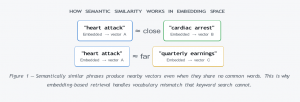
This geometric representation is what makes RAG so powerful compared to simple keyword search. A user might ask about “chest pain and shortness of breath” while the document uses the clinical phrase “acute coronary syndrome.” A keyword search would find no match. An embedding-based search would recognize the semantic overlap and retrieve the document.
The Same Model Must Be Used Throughout
A critical consistency requirement: the embedding model used to convert documents into vectors during indexing must be the exact same model used to convert the user’s query into a vector at retrieval time. If they differ, the query vector will live in a different geometric space than the document vectors, and similarity comparisons will be meaningless—like measuring distances in miles and comparing them to distances in kilometers without converting.
WHY EMBEDDINGS CAPTURE MEANING
Embedding models are trained on massive text corpora to predict which sentences appear in similar contexts. Through this training, they learn that “doctor” and “physician” are interchangeable in most contexts, that “Paris” is associated with “France” and “capital city,” and that “refund” and “return policy” co-occur with similar surrounding language. This statistical learning is what gives embeddings their semantic richness — they encode the patterns of human language use, not just surface word forms.
4. Document Chunking — Why Splitting Matters
Before documents can be embedded and stored, they must be split into smaller pieces called chunks. This step is more consequential than it might first appear.
If you embed an entire 50-page report as a single vector, that vector becomes an averaged representation of every topic in the document—financial data, technical specifications, executive summary, and appendices all blended together. When a user asks a narrow question, that blended vector will weakly match many queries but precisely match none. Retrieval breaks down.
Chunking ensures that each embedded unit represents a single, focused idea. When the user asks about the refund policy, the retrieval system surfaces the specific chunk about refund policies—not a blurry average of the entire terms-of-service document.
The Core Tension in Chunking
Every chunking decision navigates a fundamental tension:
|
|
SMALLER CHUNKS | LARGER CHUNKS |
|
Retrieval Precision |
Higher—each chunk is semantically focused |
Lower—vector averages multiple topics |
|
Context for Generation |
Lower—A single sentence may lack surrounding context |
Higher—the LLM receives a richer background |
| Storage Cost | More chunks, more vectors to store and search |
Fewer chunks, cheaper to maintain |
The practical resolution is to find a middle ground—typically paragraph-sized chunks of 200 to 500 words—with a small overlap between consecutive chunks. The overlap ensures that a sentence sitting at the boundary between two chunks is not severed from its surrounding context. It appears in both chunks, preserving meaning at every retrieval unit boundary.
THE BOUNDARY PROBLEM
Imagine splitting a document at a fixed character count. A critical sentence might begin at the end of chunk 4 and conclude at the start of chunk 5. If only chunk 4 is retrieved, the sentence is incomplete. If only chunk 5 is retrieved, it lacks its introductory clause. Neither chunk fully conveys the idea. Overlap prevents this by ensuring both chunks contain the full sentence—a small but important insurance mechanism.
5. Retrieval Mechanics — Finding the Right Information
With documents chunked and embedded, the retrieval problem reduces to a single question: given the user’s query—also embedded into a vector—which stored vectors are most similar to it?
This is solved by similarity search: the query vector is compared against every stored document vector, and the top-k most similar ones are returned. “Most similar” is typically measured by cosine similarity—the cosine of the angle between two vectors. Vectors pointing in the same direction (angle near zero, cosine near 1) are highly similar; vectors pointing in opposite directions are highly dissimilar.
Keyword Search vs. Semantic Search
It is worth being explicit about the difference between the retrieval approach RAG uses and the keyword search most people are familiar with:
|
PROPERTY |
KEYWORD SEARCH (BM25) | SEMANTIC SEARCH (EMBEDDINGS) |
|
Matching basis |
Exact word overlap between query and document | Conceptual similarity in learned vector space |
|
Handles synonyms |
No — “car” ≠ “automobile” | Yes — both embed nearby |
| Handles paraphrases | No |
Yes |
| Exact term matching | Reliable — serial numbers, codes, names |
Unreliable — similar terms may conflate |
| Out-of-domain robustness | High — no learned parameters |
Variable — depends on training domain of embedding model |
Neither approach is universally superior. The most robust RAG systems use both in combination—semantic search for conceptual understanding and keyword search for exact term matching—then merge the ranked results. This is called hybrid retrieval.
RE-RANKING — A TWO-STAGE STRATEGY
A common production pattern is to retrieve a broad set of candidates (say, top-20) using fast vector similarity, then re-score the top candidates using a more precise but slower model that evaluates the query and each document together rather than independently. The final top-k passed to the LLM are far higher quality than a raw similarity search would produce. This two-stage approach—broad recall followed by precise re-ranking—is how most serious production RAG systems operate.
Building this type of production architecture often requires technology solutions that connect retrieval engines, databases, APIs, AI models, and existing enterprise systems.
6. How Retrieved Context Guides the LLM
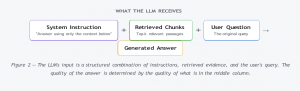
Once the relevant chunks are retrieved, they are placed into the LLM’s context window—the block of text the model reads before generating a response. The LLM sees the retrieved passages alongside the user’s original question and generates an answer that is conditioned on both. When RAG is incorporated into a customer-facing web application or internal platform, full stack development services can help connect the user interface, application logic, APIs, databases, and AI layer.
This conditioning is the mechanism by which RAG grounds the model’s output. Every token the model generates is influenced by what it read in the context window. If a relevant, accurate passage is present, the model is strongly nudged toward an accurate answer. If no relevant passage is
present, the model must fall back on its parametric memory—where errors and hallucinations live.
The Context Window Is Finite
A context window can hold a limited number of tokens — words and word fragments. Every retrieved chunk consumes part of that budget. Retrieving too many chunks fills the window with marginally relevant content and may push the most important passages toward the middle of the input, where research has shown models attend less reliably. Retrieving too few risks missing the passage that actually contains the answer.
This is why retrieval quality — not LLM quality — is typically the bottleneck in a RAG system. A mediocre retriever handing poor context to a brilliant LLM will produce worse results than a strong retriever handing excellent context to a modest LLM. The model can only work with what it is given.
THE INSTRUCTION THAT MAKES OR BREAKS RAG
The system prompt instruction — how you tell the model to use the retrieved context — has an outsized effect on output quality. Telling the model to “answer only from the provided context and say ‘I don’t know’ if the answer isn’t there” is the single most effective guardrail against hallucination in a RAG system. Without it, the model will seamlessly blend retrieved content with its own parametric knowledge, and the output becomes unverifiable.
7. Why RAG Reduces Hallucination — But Does Not Eliminate It
One of the most common misconceptions about RAG is that it solves hallucination. It does not. It substantially reduces a specific category of hallucination, while leaving others fully intact.
Understanding the difference matters for setting realistic expectations and designing appropriate safeguards.
What RAG Fixes
RAG directly addresses knowledge-gap hallucination — the type where the model fabricates an answer because the correct information was absent from its training data or beyond its knowledge cutoff. By supplying the correct information in context, RAG removes the need for the model to guess.
What RAG Does Not Fix
Retrieval failure. If the retriever does not surface the relevant document — because the query was ambiguous, the chunk was too large, or the embedding model failed to capture the semantic relationship — the LLM receives no grounding for that fact and may hallucinate from parametric memory. The generation failure is entirely caused by an upstream retrieval failure.
Parametric override. LLMs have strong prior beliefs baked into their weights. When retrieved
context contradicts something the model “knows” very confidently from training, the model may subtly override or blend the retrieved information with its own prior — producing an answer that partially contradicts the source document it was handed.
Reasoning errors. Even when retrieval is perfect and context conditioning is correct, the model can still reason incorrectly — drawing a wrong conclusion from correct premises. This is a reasoning failure, not a retrieval failure, and RAG architecture alone cannot address it.
THE HONEST SUMMARY
RAG makes hallucination less likely by giving the model something real to work with. It does not make the model more truthful, more careful, or more reliable as a reasoner. Those properties depend on the model itself — on how it was aligned, fine-tuned, and evaluated. RAG is a knowledge supply mechanism, not a truthfulness guarantee.
8. Evaluating a RAG System — What Good Looks Like
A RAG system can fail in two distinct places — retrieval and generation — and evaluation must address both independently. Treating the system as a single black box produces misleading results: a high overall answer quality score could mask a terrible retriever being compensated by an exceptional generator, or vice versa.
Evaluating Retrieval Quality
The retrieval layer is evaluated by asking: did the relevant chunk appear in the top-k results? The key metrics are:
|
METRIC |
WHAT IT MEASURES |
|
Recall@k |
Of all the relevant chunks that exist in the corpus, what fraction appeared in the top-k results? |
| Precision@k |
Of the k chunks retrieved, what fraction were actually relevant? |
| MRR (Mean Reciprocal Rank) |
On average, how high in the ranked list was the first relevant result? Higher is better. |
Evaluating Generation Quality
Given good retrieved context, did the LLM generate a good answer? The key dimensions are:
Faithfulness. Does every factual claim in the answer appear in the retrieved context? Claims that cannot be traced to the context are hallucinations — regardless of whether they happen to be true.
Answer relevance. Does the answer actually address what the user asked? A faithful answer can still miss the point of the question entirely.
Context utilization. How much of the retrieved context contributed to the answer? Low utilization suggests the retriever is returning chunks the generator ignores — a signal to improve retrieval precision.
EVALUATION WITHOUT GROUND-TRUTH LABELS
Creating a labelled evaluation set — where a human has written the ideal answer for every test question — is expensive and time-consuming. Modern RAG evaluation frameworks like RAGAS address this by using a separate LLM as an automated judge, scoring faithfulness and relevance by checking whether the answer is logically supported by the retrieved context. This is not perfect — the judge LLM has its own biases — but it enables evaluation at a scale that manual labelling cannot match.
Planning a RAG or AI-powered application? Talk to our AI experts to explore how retrieval, enterprise data, and language models can work together for your use case.