
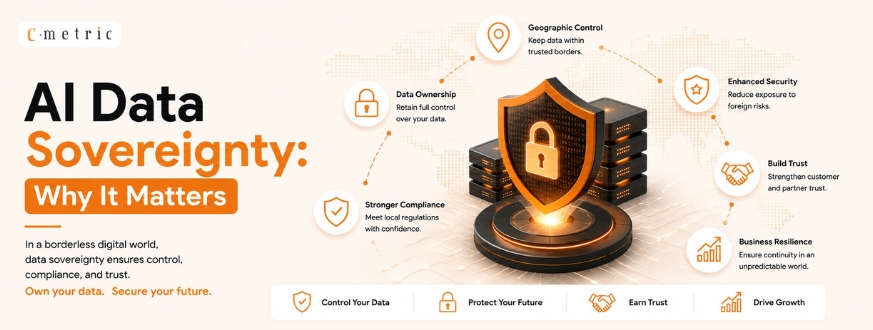
AI Data Sovereignty: Why It Matters
Organizations now have new ways to manage data, and AI is at the center of this transformation. However, AI systems extensively rely on cloud infrastructure and global data flows. This adds concerns around ownership, jurisdiction, privacy, and compliance.
Imagine training an AI model on customer data collected in Germany, storing that data in a cloud region outside the European Union, and using a third-party model hosted in another country for inference.
The AI application may function perfectly. The compliance risks may not. This is where AI Data Sovereignty becomes critical.
It’s a bit different from traditional data governance, which focuses on protecting information. AI Data Sovereignty addresses a broader challenge: maintaining control over data, models, infrastructure, and AI operations across jurisdictions.
Businesses working with a Custom Software Development Company in USA are increasingly evaluating sovereignty requirements early in the development process rather than treating compliance as an afterthought.
Understanding AI Data Sovereignty
What is Data Sovereignty?
To understand AI Data Sovereignty, it is important to understand what is data sovereignty. So, let’s talk about it first.
According to IBM, data sovereignty means that data is subject to the laws of the country/region where it is generated. This principle determines how information can be stored, processed, transferred, and protected across borders.
For traditional applications, this primarily affects databases and storage systems. For AI systems, the implications are much broader. The types of data that may fall under sovereignty requirements are:
- Training data
- Prompts
- Embeddings
- Model outputs
- Logs
- Monitoring data
The Rise of AI and Cloud Environments
Modern AI development depends heavily on cloud infrastructure. Organizations no longer need to build expensive infrastructure to train models or deploy intelligent applications.
However, the same has introduced new sovereignty challenges.
Modern AI systems often involve multiple components operating across regions:
- Data collection and storage
- Data labeling and preparation
- Model training and fine-tuning
- Deployment and inference
- Monitoring and governance
Data may move across multiple regions during different phases. This raises questions about compliance, ownership, and governance. Hence, organizations are increasingly focusing on Cloud Sovereignty strategies that provide greater control over where data is stored and how it is processed.
Importance for AI Developers and Organizations
AI sovereignty extends beyond regulatory compliance. It is an organization’s or nation’s ability to control its AI stack. For developers, this means architectural decisions now have governance implications.
Strong AI sovereignty practices help organizations:
- Regulatory compliance
- Data protection
- Intellectual property control
- Vendor risk reduction
- Ethical AI deployment
- Long-term operational resilience
Key Challenges in Implementing AI Data Sovereignty
Regulatory and Legal Complexities
Organizations operating globally must navigate a complex web of regulations governing all processes related to the data. Different countries enforce unique requirements, making compliance particularly challenging for AI applications that rely on distributed infrastructure.
Key challenges include:
- Cross-border data regulations
- Privacy compliance challenges
- Data residency requirements
Regulatory frameworks such as GDPR, sector-specific regulations, and emerging AI governance laws continue to evolve, requiring ongoing monitoring and adaptation. Many organizations explore specialized data sovereignty solutions to address these obligations effectively.
Technical and Operational Barriers
Meeting sovereignty requirements often involves significant adjustments.
Organizations may need to redesign architectures to ensure data remains within approved jurisdictions. This can affect storage strategies, disaster recovery planning, model training pipelines, and vendor selection.
Enabling AI Data Sovereignty may also require taking measures, such as:
- Enhanced encryption
- Localized infrastructure
- Region-specific access controls
- Detailed audit capabilities.
These measures demand close collaboration between legal, security, and engineering teams. Implementing them can increase complexity and operational costs, too.
Balancing Innovation and Compliance
Businesses often want to leverage advanced AI capabilities while maintaining control over sensitive information. Achieving this balance requires implementing efficient AI sovereignty and governance frameworks capable of:
- Risk-based assessments
- Privacy-enhancing technologies
- Careful evaluation of data-sharing practices.
Best Practices for AI Data Sovereignty
Designing Systems with Data Sovereignty in Mind
Organizations should prioritize privacy-by-design principles. Regional hosting strategies, encryption standards, and localized processing capabilities should be considered from the planning phase itself. It’ll help teams create Artificial Intelligence systems that minimize unnecessary data collection, limit exposure, and support compliance from the start.
Monitoring, Auditing, and Governance
Compliance is not a one-time activity. Continuous oversight helps maintain AI Data Sovereignty throughout the system lifecycle. Important governance practices include:
- Data access controls
- Compliance audits
- Transparency reporting
Organizations should also document policies, establish accountability structures, and maintain audit trails that demonstrate adherence to AI Data Sovereignty requirements.
Leveraging Cloud Sovereignty Solutions
Cloud providers increasingly offer services designed to support sovereignty requirements.
When evaluating vendors, organizations should assess factors such as:
- Data residency options
- Encryption controls
- Operational transparency
- Regulatory certifications
- Regional infrastructure availability.
Modern cloud sovereignty offerings can help organizations maintain greater control over sensitive information while still benefiting from cloud scalability and AI capabilities.
Real-World Applications and Case Studies
Successful AI Data Sovereignty Implementations
Several industries have already embraced data sovereignty solutions and sovereignty-focused AI strategies.
For example, healthcare providers use localized AI environments to analyze patient information. The details are kept, accessed, or shared while protecting privacy and maintaining compliance.
Similarly, financial institutions implement regional controls while ensuring that customer data is processed as per appropriate regulations and security policies.
Government agencies deploy sovereign cloud setups to protect sensitive national information.
Lessons Learned from Non-Compliance
Overlooking sovereignty requirements may cause serious consequences for enterprises. A few examples are:
- Regulatory investigations
- Financial penalties
- Service disruptions
- Loss of customer trust
- Increased operational costs
Businesses seeking guidance from a Software Company Delivering Custom Solutions in NJ or similar technology partners often prioritize governance assessments early in the project lifecycle to identify risks before deployment.
Key Takeaways for Developers
While implementing AI Data Sovereignty, it is recommended that developers make sure to do the following:
- Understand jurisdictional requirements before development begins
- Map data flows across the AI lifecycle
- Limit unnecessary data movement
- Maintain detailed audit records
- Evaluate third-party AI providers carefully
- Design systems with sovereignty requirements in mind from day one
Future Outlook
Emerging Regulations and Standards
Governments and regulatory bodies continue to introduce new frameworks addressing AI governance and data protection. Future regulations are expected to place greater emphasis on transparency and accountability through these frameworks. And therefore, organizations must stay prepared to adapt their governance models accordingly.
The growing importance of data sovereignty suggests that compliance considerations will become an increasingly significant factor in AI architecture and infrastructure decisions. Gartner predicts that nations building sovereign AI capabilities may need to invest at least 1% of GDP in AI infrastructure by 2029
Preparing for Global AI Compliance
Organizations should assume that sovereignty requirements will become more comprehensive over time. It’s better to be prepared for:
- Cross-border data protection
- Ethical AI deployment
Businesses that proactively align with international regulations and ethical AI standards will be better positioned to manage risk, build trust, and operate across multiple jurisdictions.
Conclusion
AI systems rely heavily on cloud infrastructure and third-party services. That’s what has made sovereignty a critical business and technology concern.
Not knowing what is data sovereignty can be harmful for enterprises today.
Ultimately, AI Data Sovereignty is about more than where data is stored. It helps organizations maintain control over data, infrastructure, models, and operations. AI Data Sovereignty enables businesses to meet regulatory obligations and supports responsible AI development.
As AI adoption grows, organizations that prioritize sovereignty will be better positioned to build trustworthy, compliant, and resilient AI systems for the future.