
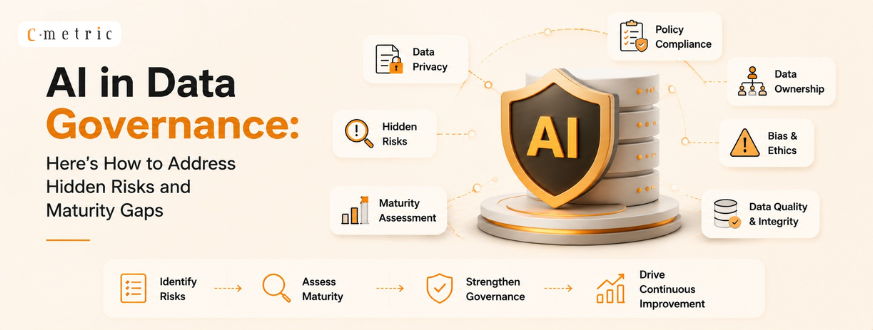
AI in Data Governance: Here’s How to Address Hidden Risks and Maturity Gaps
Data is the most valuable asset modern organizations own and the most mismanaged. As enterprises scale their AI programs, the gaps in their data governance frameworks are becoming impossible to ignore. Poor data quality, unclear ownership, untracked lineage, and inconsistent compliance controls are not just operational inconveniences; they are business risks that compound over time.
AI in data governance is emerging as the most effective way to close these gaps at scale by bringing automation, intelligence, and continuous monitoring to a discipline that manual processes have never fully addressed. Organizations that govern their data well build AI systems that perform well. Those that do not are building on unstable ground.
Why Data Governance Is More Critical Than Ever
The Hidden Costs of Weak Data Governance
Most organizations significantly underestimate the true cost of poor data governance. On the surface, it manifests as inconsistent reports, duplicate records, and data quality complaints from analysts. Beneath the surface, it drives flawed AI model outputs, failed regulatory audits, and business decisions made on unreliable information.
A weak data governance strategy actively undermines the ROI of every AI and analytics investment the organization makes. AI models trained on poorly governed data inherit its flaws, biased inputs produce biased outputs, and no model sophistication compensates for poor data quality management at the source.
What a Maturity Gap Looks Like in Practice
Data governance maturity gaps are rarely obvious. They accumulate quietly through years of rapid data growth, siloed systems, and under-resourced governance teams. Common signs include:
- No clear ownership assigned to critical data assets
- Data lineage that cannot be traced end-to-end across systems
- Compliance controls that exist on paper but are not enforced in practice
- AI governance risks emerging from models trained on unvalidated datasets
Why Traditional Governance Methods Are Falling Short
Manual governance processes were designed for a different era, one with smaller data volumes and simpler regulatory environments. Today’s data landscape is too large, too fast-moving, and too complex for spreadsheet-based catalogues and quarterly audits. AI data management is not a luxury; it is the only realistic path to governance at scale.
How AI in Data Governance Addresses Hidden Risks?
-
Automated Data Discovery and Classification
One of the most persistent governance challenges is simply knowing what data exists and where it lives. AI in data governance solves this through automated discovery continuously scanning data environments, classifying data by type and sensitivity, and surfacing previously unknown data stores that carry compliance and security risk.
Organizations cannot govern data they do not know exists. AI-powered discovery replaces manual cataloguing with continuous, real-time visibility across structured, unstructured, and semi-structured environments.
-
AI-Powered Data Quality Management
Data quality management is where governance programs most frequently fail when relying on manual processes. Errors accumulate faster than reviewers can catch them, and by the time issues are identified, they have already propagated across downstream systems and AI models.
AI in data governance brings continuous, automated quality monitoring, detecting anomalies, flagging inconsistencies, and triggering remediation workflows in real time. Quality issues are caught at the point of entry rather than discovered months later during an audit or model performance review.
-
Proactive Risk Detection and Compliance Monitoring
Regulatory environments are tightening globally. GDPR, CCPA, HIPAA, and emerging AI-specific regulations require organizations to demonstrate ongoing compliance not just at audit time. AI data management tools continuously monitor data usage, access patterns, and policy adherence, surfacing compliance risks before they become violations.
Key Risk Areas AI Governance Addresses
- Regulatory non-compliance– Automated monitoring ensures data handling aligns with applicable laws at all times
- Data lineage gaps– AI traces data movement across systems, making lineage transparent and auditable
- Model training risks– Governance controls validate that AI models are trained on accurate and compliant datasets
- Access control violations– AI detects and flags unauthorized data access in real time
Build a Stronger Data Governance Framework with AI
-
Define a Data Governance Strategy That Scales
A robust data governance framework built with AI capabilities must rest on three pillars: clear policy definition, intelligent automation, and measurable accountability. Policy alone is insufficient, frameworks succeed only when policies are enforced automatically at scale and when every data asset has a traceable, accountable owner.
An effective data governance strategy maps every critical data domain to a business owner, defines clear quality standards and lineage requirements, and uses AI-powered data governance tools to enforce those standards continuously across the entire data estate.
-
Select the Right Data Governance Tools
When evaluating tools, organizations should prioritize:
- Automated metadata management– AI-generated catalogues that stay current without manual curation
- Real-time quality monitoring– Continuous validation rather than scheduled batch checks
- Policy enforcement automation– Governance rules that apply themselves across all data pipelines
- Lineage visualization– End-to-end traceability across complex, multi-system data flows
-
Close the Maturity Gap Step by Step
Closing a governance maturity gap is a structured progression, not a single project:
- Assess the current state– Audit existing data assets, ownership structures, and policy coverage
- Prioritize high-risk domains– Focus initial improvements on data driving AI models and regulatory reporting
- Automate incrementally– Introduce AI data management capabilities progressively, starting with discovery and quality monitoring
- Measure and iterate– Establish governance maturity metrics and review them regularly to track progress
Conclusion
The organizations winning with AI in 2026 are the ones that built strong data governance foundations before scaling their AI programs. Enterprise AI in data governance closes the maturity gaps that manual processes created, replacing reactive audits with continuous automated intelligence. A well-governed data estate is not just a compliance asset, it is a competitive one, producing more accurate AI models, more reliable business insights, and significantly lower regulatory risk. The hidden risks of weak governance are real, measurable, and solvable but only for organizations willing to invest in the right strategy and the right expertise.
Build Governed and Scalable AI with C-Metric
C-Metric helps organizations design and implement data governance frameworks built for the AI era. From automated data discovery and quality management to compliance monitoring and AI governance risk assessment, C-Metric delivers end-to-end solutions that close maturity gaps and create data environments where AI performs at its best.
Our team of data engineers, AI specialists, and governance consultants works with organizations across Healthcare, Financial Services, Retail, and Manufacturing to build governance programs that are practical, scalable, and measurably effective.
Ready to close your data governance gaps and build AI on solid ground? Get in touch with us to leverage our enterprise AI governance services.
Frequently Asked Questions
What is AI in data governance?
AI in data governance refers to the use of artificial intelligence to automate and enhance how organizations manage, protect, and ensure the quality of their data. It includes automated data discovery, real-time quality monitoring, compliance enforcement, and lineage tracking, capabilities that manual governance processes cannot deliver at scale.
What is a data governance framework?
A data governance framework is a structured set of policies, roles, processes, and technologies that define how an organization manages its data assets. It establishes accountability for data quality, security, compliance, and accessibility, ensuring data is reliable, well-understood, and used appropriately across the organization.
What are the biggest risks in AI data management?
The biggest risks include training AI models on poor-quality or biased data, failing to maintain auditable data lineage, inadequate access controls, and compliance failures due to inconsistent policy enforcement. AI-powered governance tools directly address each of these risk categories.
How do data governance tools support compliance?
Data governance tools support compliance by continuously monitoring data usage and access patterns, enforcing data handling policies automatically, maintaining audit-ready lineage records, and flagging potential violations in real time by enabling organizations to demonstrate ongoing compliance rather than scrambling to document it at audit time.