
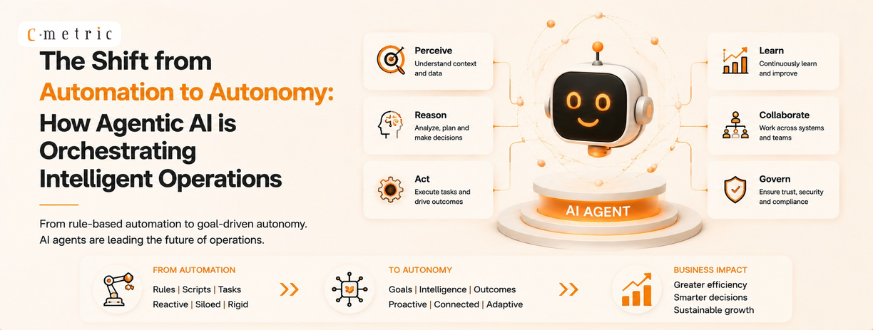
The Shift from Automation to Autonomy: How Agentic AI is Orchestrating Intelligent Operations
For decades, automation promised to make businesses faster and leaner, and it delivered, up to a point. Rule-based automation eliminated repetitive tasks, reduced manual errors, and cut costs across industries. But automation has a ceiling. It executes instructions. It does not think. The next leap is not faster automation; it is autonomy. Agentic AI represents that leap: AI systems that do not just follow rules but reason, plan, and act independently to achieve complex business goals. The shift from automation to autonomy is already underway, and organizations that move on it now will define what intelligent operations look like for the next decade.
Understand the Difference Between Automation vs Autonomy
What Automation Can and Cannot Do
Intelligent automation transformed operations by replacing manual and repetitive workflows with software-driven processes. Robotic Process Automation, scheduled scripts, and rule-based systems handle defined tasks predictably but only within the boundaries of what they were programmed to do.
The moment a process deviates from its expected path, an exception, an edge case, or an ambiguous input, traditional automation stalls. It escalates to a human, logs an error, or simply fails. This is where traditional automation reaches its limit, and where AI agents begin to create value.
What Makes Agentic AI Different
Agentic AI operates on an entirely different paradigm. Rather than executing a fixed sequence of steps, an Agentic AI system is given a goal and determines for itself how to achieve it. It reasons through available information, selects the right tools, executes a multi-step plan, monitors outcomes, and adjusts when conditions change, all without human direction at each stage.
This is not a marginal improvement over automation. It is a structural shift in how AI interacts with business operations.
The Three Layers of the Shift
- Automation– Executes predefined rules; handles known inputs only; zero adaptability
- Intelligent Automation– Adds decision logic but still operates within structured boundaries
- Agentic AI– Reasons, plans, acts, and self-corrects across dynamic and unstructured environments
How Agentic AI Orchestrates Intelligent Operations
-
Multi-Agent Systems and Workflow Orchestration
One of the most powerful capabilities of Agentic AI is AI orchestration, the coordination of multiple specialized AI agents working together toward a shared objective. In an orchestrated system, one agent gathers and analyzes data, another generates recommendations, a third executes actions across integrated platforms, and an orchestrating agent manages the sequence and resolves conflicts in real time.
This multi-agent architecture enables enterprises to automate entire business processes end-to-end not just individual tasks. Complex workflows that previously required multiple human touchpoints and approvals can now be managed autonomously by a coordinated network of Agentic AI systems.
-
Dynamic Decision-Making at Scale
Traditional enterprise AI automation surfaces recommendations for humans to act on. Agentic AI goes further; it makes decisions and executes them within defined boundaries, escalating to humans only when genuinely necessary.
This transforms AI-driven operations across every business function. In supply chain management, Agentic AI autonomously reroutes logistics in response to disruptions. In finance, it flags and investigates anomalies without waiting for an analyst. In IT operations, it detects, diagnoses, and resolves infrastructure issues before they impact users. The speed and consistency of autonomous decision-making at scale is something human-in-the-loop processes cannot match.
-
Continuous Learning and Self-Optimization
Agentic AI systems do not plateau. Every completed workflow, every decision outcome, and every exception encountered becomes a training signal that makes the system more precise over time. This continuous learning loop means autonomous AI systems compound their value by delivering progressively better outcomes the longer they operate.
Where Agentic AI Orchestration Delivers the Greatest Impact
- IT and infrastructure– Autonomous monitoring, incident detection, and resolution
- Supply chain and logistics– Dynamic demand forecasting and disruption response
- Finance and compliance– Automated anomaly detection and regulatory reporting
- Sales and marketing– Intelligent lead scoring and personalized campaign orchestration
- HR operations– Automated onboarding workflows and employee query resolution
Why Are Enterprises Moving to Agentic AI Now?
-
The Limitations of the Current Automation Stack
Most enterprise automation stacks are aging. They were built for predictable, linear processes in a world that has become dynamic and non-linear. Maintenance costs are rising. Exception queues are growing. The human oversight burden that was supposed to shrink with automation has, in many organizations, stayed constant because existing systems still cannot handle edge cases.
Agentic AI workflow automation directly addresses these limitations by building adaptability and contextual reasoning into the operational layer, replacing brittle rule-based systems with intelligent systems that handle exceptions as competently as standard cases.
-
Business Outcomes That Drive Adoption
The business case for Agentic AI is increasingly concrete:
- Reduced operational costs– Autonomous task resolution cuts labor costs and rework
- Faster cycle times– Processes that took days to complete in minutes without coordination overhead
- Higher accuracy– AI-driven operations eliminate the inconsistency that affects human-executed processes
- Better scalability– Autonomous systems scale with demand without proportional increases in headcount
- Improved compliance– Consistent policy enforcement across every workflow instance
-
The Readiness Question
Transitioning from automation to autonomy requires readiness across three dimensions: data infrastructure quality, integration architecture maturity, and AI governance frameworks. Organizations that have invested in clean data pipelines, well-documented APIs, and governance controls are best positioned to deploy Agentic AI at scale without introducing new operational risks.
Conclusion
The shift from automation to autonomy is not a distant future scenario, it is the operating reality leading organizations are building toward right now. Agentic AI moves businesses beyond the ceiling of rule-based automation, delivering intelligent operations that reason, adapt, and self-improve at a scale no human-in-the-loop process can match. The competitive divide between organizations that adopt autonomous AI systems and those that do not is widening every quarter. The time to understand Agentic AI and act on it is now.
Build Intelligent Operations with C-Metric
C-Metric specializes in designing and deploying Agentic AI solutions that transform how enterprises operate. From multi-agent workflow orchestration and autonomous decision-making systems to enterprise AI automation and continuous learning pipelines, C-Metric builds AI-driven operations infrastructure tailored to your industry, your processes, and your growth goals.
Our team of AI architects and operations specialists works with you from strategy through deployment by ensuring your Agentic AI investment is secure, scalable, and delivering measurable operational improvements from day one.
Ready to move beyond automation and build truly intelligent operations? Connect with our experts at C-Metric to leverage top-of-the-line Agentic AI services and improve operational efficiency across business functions with minimum human supervision.
Frequently Asked Questions
What is Agentic AI?
Agentic AI refers to artificial intelligence systems that can independently set goals, reason through available information, make decisions, and execute multi-step actions to complete complex tasks without human direction at each step. Unlike traditional automation, Agentic AI adapts to changing conditions and handles exceptions autonomously.
How is Agentic AI different from intelligent automation?
Intelligent automation adds decision logic to rule-based systems but still operates within predefined boundaries. Agentic AI reasons through dynamic, unstructured environments, coordinates multiple tools and systems, and self-corrects when outcomes deviate by making it fundamentally more capable than any form of traditional intelligent automation.
What is AI orchestration in enterprise operations?
AI orchestration is the coordination of multiple specialized AI agents working together to complete complex, multi-step business processes. An orchestrating agent manages the sequence, monitors outcomes, and resolves conflicts, enabling enterprises to automate entire workflows end-to-end rather than isolated individual tasks.
What industries benefit most from Agentic AI workflow automation?
IT operations, supply chain and logistics, financial services, sales and marketing, and HR functions see the strongest early results from Agentic AI workflow automation. Any business function with high process volume, frequent exceptions, or complex multi-system workflows stands to gain significantly from autonomous AI systems.