
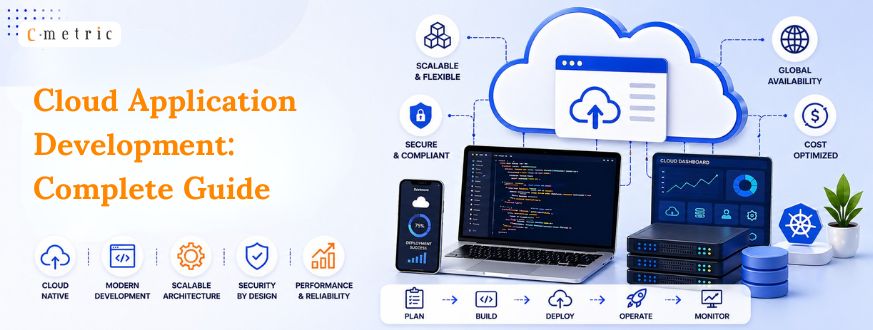
Cloud Application Development: Complete Guide
Businesses across every sector are rethinking how their software is built, hosted, and scaled and Cloud Application Development is at the center of that transformation. As organizations move away from legacy, on premise systems toward agile, internet-delivered platforms, the ability to design and deploy applications in the cloud has become one of the most valuable capabilities a technology team can possess. Cloud Application Development is not just a technical discipline, it is a strategic enabler that drives speed, scalability, and innovation. In this complete guide, we cover what cloud application development means, the different types of cloud apps, the key benefits, the technologies and processes involved, real-world use cases, common challenges, and what the future holds for cloud-first organizations.
What is Cloud Application Development?
Cloud based application development is the practice of designing, building, deploying, and managing software applications that run on cloud infrastructure rather than traditional on premise servers. Instead of installing and maintaining hardware in a company’s own data center, cloud applications are hosted on remote servers provided by cloud platforms such as Amazon Web Services (AWS), Microsoft Azure, or Google Cloud and accessed by users over the internet.
The key distinction from traditional application development lies in how resources are provisioned and consumed. Legacy applications are typically tied to fixed physical infrastructure, making them costly to scale and difficult to update. Cloud Application Development, by contrast, leverages virtualized, on-demand computing resources that can be scaled instantly, updated continuously, and accessed from anywhere in the world. This shift fundamentally changes how software teams build, test, and maintain applications, enabling faster innovation cycles and far greater operational flexibility.
Types of Cloud Application Development
Not all cloud applications are built the same way. Understanding the different approaches to Cloud Application Development is essential for choosing the right architecture for your business needs. The three primary types are:
Cloud-Native Applications
Cloud-native application development refers to building software that is designed from the ground up to run in cloud environments. These applications are typically built using microservices architecture, packaged in containers (such as Docker), orchestrated with Kubernetes, and deployed via automated CI/CD pipelines. Cloud-native apps are engineered for scalability, resilience, and continuous delivery, taking full advantage of the elasticity and distributed nature of cloud platforms. They are ideal for businesses that want maximum agility and performance at scale.
Hybrid Cloud Applications
Hybrid cloud applications operate across a combination of on premise infrastructure and one or more public cloud environments. This approach is particularly well-suited to enterprises that have significant existing investments in physical infrastructure but want to gradually migrate workloads to the cloud. Sensitive data or regulatory workloads can remain on premise while other services such as customer-facing applications or analytics platforms run in the cloud, giving organizations the best of both environments.
Multi-Cloud Applications
Multi-cloud applications are deployed across two or more cloud providers simultaneously for example, running compute workloads on AWS while leveraging Google Cloud’s AI and machine learning services. This strategy gives businesses greater flexibility, avoids dependence on any single vendor, and allows teams to optimize each workload for the cloud platform best suited to it. Multi-cloud architectures also improve availability and disaster recovery resilience by distributing risk across multiple provider networks.
Key Benefits of Cloud Application Development
The business case for custom cloud application development is compelling across organizations of every size. Here is a closer look at the four most impactful benefits:
Scalability & Flexibility
Cloud infrastructure allows applications to scale compute, storage, and networking resources up or down in real time, responding automatically to changes in user demand. Whether you are handling a Black Friday traffic surge or onboarding thousands of new enterprise customers, cloud applications can expand capacity within minutes rather than the weeks or months required to provision physical hardware. This elasticity is a fundamental competitive advantage for growing businesses.
Cost Efficiency
The pay-as-you-go pricing model of cloud platforms eliminates the need for large upfront capital investment in servers, data center space, and maintenance contracts. Businesses pay only for the resources they consume and can reduce costs further through reserved capacity pricing and auto-scaling policies that shut down unused resources during off-peak periods. The total cost of ownership for cloud applications is consistently lower than equivalent on premise deployments.
Enhanced Security
Leading cloud providers invest billions annually in security infrastructure, compliance certifications, and threat intelligence. Cloud Application Development gives businesses access to enterprise-grade security capabilities including encryption at rest and in transit, identity and access management, DDoS protection, and automated vulnerability scanning that would be prohibitively expensive to replicate on premise. Cloud platforms also maintain compliance with major regulatory frameworks including GDPR, HIPAA, SOC 2, and ISO 27001.
Faster Deployment
Cloud environments are purpose-built for speed. Development teams can provision new environments in minutes, deploy code changes multiple times per day through automated pipelines, and roll back releases instantly if issues arise. This acceleration of the development lifecycle supports agile and DevOps methodologies by enabling teams to ship features faster, respond to user feedback more quickly, and maintain a continuous cadence of product improvement.
Technologies Used in Cloud Application Development
Modern Cloud Application Development draws on a rich and rapidly evolving technology stack. From the programming languages used to write application logic, to the platforms that host and orchestrate it, here are the key technologies shaping the field including leading AWS cloud application development services and their equivalents across major providers:
- Programming Languages: Python, Java, and Node.js are the most widely used languages for cloud application development, valued for their extensive library ecosystems, cloud SDK support, and performance characteristics at scale.
- Cloud Platforms: Amazon Web Services (AWS), Microsoft Azure, and Google Cloud Platform are the three dominant providers, each offering hundreds of managed services covering compute, storage, databases, AI, networking, and developer tooling.
- Containers & Microservices: Docker enables consistent application packaging, while Kubernetes orchestrates containerized workloads at scale. Micro services architecture breaks applications into independently deployable services byimproving maintainability and enabling teams to release individual components without affecting the entire system.
- Serverless Computing: AWS Lambda, Azure Functions, and Google Cloud Functions allow developers to run code without managing servers further reducing operational overhead and enabling highly granular, event-driven application architectures.
- APIs & DevOps Tools: RESTful and GraphQL APIs connect cloud services and front-end interfaces, while DevOps tools such as GitHub Actions, Jenkins, Terraform, and Prometheus automate the build, deployment, monitoring, and management of cloud applications.
Cloud Application Development Process
Building a cloud application successfully requires a structured, phased approach. The Cloud Application Development process typically follows these key stages:
1. Planning & Requirement Analysis
Every successful cloud application begins with a clear understanding of the problem it is solving. This phase involves working closely with business stakeholders to define functional and non-functional requirements, identify target users, assess regulatory or compliance constraints, and establish success metrics. Technology decisions at this stage including cloud provider selection and deployment model should be driven by business goals, not the other way around.
2. Design & Architecture
With requirements in hand, architects design the application’s structural blueprint. This includes selecting the appropriate cloud architecture pattern whether microservices, serverless, or monolithic, designing the data model, defining API contracts, planning security controls, and mapping the network and infrastructure topology. Getting architecture right at this stage is critical: changes become exponentially more expensive the later they are made in the development lifecycle.
3. Development & Integration
Development teams build individual application components using the agreed technology stack, integrating cloud services such as managed databases, authentication providers, storage buckets, and messaging queues via well-defined APIs. Modern cloud development favours iterative, sprint-based delivery over long waterfall cycles, allowing working software to be reviewed and validated continuously throughout the build phase.
4. Testing & Deployment
Rigorous testing across multiple dimensions including unit tests, integration tests, load tests, and security penetration tests ensures the application performs correctly, handles peak traffic gracefully, and meets compliance requirements before it reaches production. Deployment is managed through CI/CD pipelines that automate the process of pushing validated code to cloud environments, enabling teams to ship updates with confidence and consistency.
Use Cases of Cloud Application Development
The versatility of Cloud Application Development means it powers an extraordinarily wide range of products and platforms. Here are some of the most common and impactful use cases across industries:
- Web and Mobile Applications: From consumer-facing apps to internal business tools, cloud infrastructure provides the scalability, global availability, and reliability that modern web and mobile applications demand.
- SaaS Platforms: Software-as-a-Service products are the natural home of cloud-native application development by enabling vendors to deliver continuously updated software to thousands of customers simultaneously, with no installation required.
- eCommerce Platforms: Cloud applications handle the dynamic scaling demands of online retail, managing product catalogues, payment processing, inventory management, and personalisation at scale, including during high-traffic peak periods.
- Data Analytics & AI Applications: Cloud platforms provide the compute power and managed AI services required to process large datasets, train machine learning models, and deliver real-time intelligence to business decision-makers.
- Enterprise Software Solutions: ERP, CRM, and HR platforms built on cloud infrastructure benefit from custom cloud application development approaches, allowing organisations to tailor enterprise software precisely to their workflows while maintaining the scalability and security that cloud provides.
Explore C-Metric’s Cloud Application Development Services to learn how we deliver these solutions for businesses across industries.
Challenges in Cloud Application Development
While the advantages of Cloud Application Development are substantial, organisations must navigate a set of real challenges to realise their full potential:
- Data Security & Compliance: Storing sensitive data in third-party cloud environments introduces security and regulatory considerations. Businesses operating in regulated industries must ensure their cloud architecture meets applicable data protection laws and industry standards and that shared responsibility models with cloud providers are clearly understood.
- Vendor Lock-In: Deep integration with a single cloud provider’s proprietary services can make it costly and complex to migrate workloads in the future. Adopting cloud-agnostic tools, open standards, and multi-cloud strategies where appropriate can mitigate this risk.
- Cost Management: While cloud is cost-efficient at scale, unmanaged cloud spend can grow quickly. Without proper tagging, budget alerts, and resource governance policies, organizations can find themselves paying for idle or over-provisioned resources.
- Skills Gap: Building and operating cloud-native applications requires expertise across a broad range of disciplines- cloud architecture, DevOps, security, containerization, and more. Access to skilled cloud professionals remains one of the most significant constraints on cloud adoption for many organizations.
Future of Cloud Application Development
The trajectory of Cloud Application Development points firmly toward greater intelligence, greater automation, and greater reach. Several powerful trends are shaping what the next chapter will look like for cloud-first organizations:
Artificial intelligence and machine learning are becoming deeply embedded in the cloud application development lifecycle itself not just in the products teams build, but in how they build them. AI-assisted code generation, automated testing, intelligent infrastructure optimization, and predictive monitoring are already reshaping developer workflows, and their influence will only deepen in the years ahead.
Serverless architecture is moving from early adopter to mainstream. As developers grow more comfortable abstracting away infrastructure management entirely, serverless-first design patterns will become the default approach for event-driven workloads, APIs, and background processing tasks further accelerating the pace of Cloud Application Development and reducing the operational burden on engineering teams.
Edge computing is expanding the geography of where cloud applications run. By processing data closer to end users at edge nodes rather than centralized data centers applications can achieve lower latency, better performance in bandwidth-constrained environments, and greater resilience. This will be particularly transformative for IoT applications, real-time analytics, and consumer-facing products with global audiences.
Ultimately, Cloud Application Development will become the universal standard for software delivery. Businesses that invest in cloud-native skills, tooling, and culture today will be far better positioned to innovate rapidly, respond to market changes, and deliver exceptional digital experiences as the technology landscape continues to evolve. For guidance on managing your cloud infrastructure at scale, explore our deep dive on Cloud Managed Services.
Conclusion
Cloud Application Development is no longer a forward-looking ambition, it is the present-day reality for organizations that want to compete, scale, and innovate effectively in 2026. From the flexibility of cloud-native architectures to the cost efficiency of pay-as-you-go infrastructure, from enterprise-grade security to AI-powered development workflows, cloud application development gives businesses the tools to move faster and build better than ever before.
The organizations that thrive in the years ahead will be those that treat cloud not as a hosting decision but as a strategic capability embedding it into how they design products, manage teams, and deliver value to customers. The technology is ready. The question is whether your business is.
Looking to build scalable cloud applications? Connect with C-Metric’s expert team today and get the guidance you need to design, build, and deploy cloud solutions that drive real business growth.