
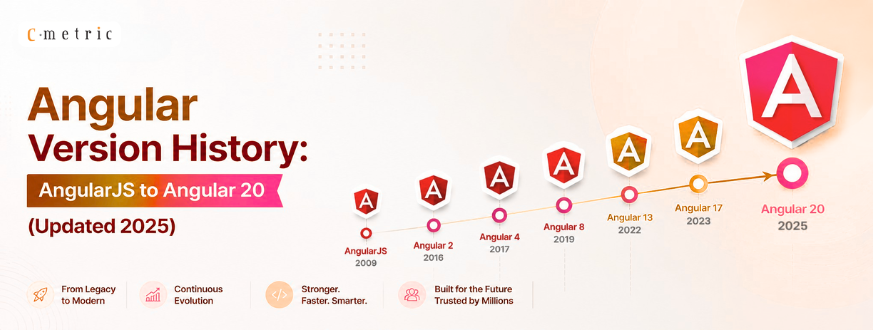
Angular Version History: AngularJS to Angular 20 (Updated 2025)
What is Angular?
Angular is a TypeScript-based open-source web application framework developed by Google. It is designed to create dynamic, efficient, and sophisticated web apps. It provides a component-based architecture and powerful development tools, making it one of the most popular front-end frameworks today. To learn more about why developers choose it, read our guide on the benefits and advantages of Angular.
Angular Version History
Angular 19.0.0
- Released on November 19, 2024.
- Actively supported version
Angular 19.1.2 (Latest Angular Version)
- Released on January 20, 2025.
- Includes bug fixes and performance improvements.
- Further optimizations for server-side rendering (SSR).
Understanding Angular version history is crucial for developers as well as stakeholders who want to stay updated with the latest Angular version and its capabilities. Below is a complete Angular versions list, including major updates and release dates.
AngularJS (Angular 1.0)
- Released in 2010 by Miško Hevery.
- Open-source JavaScript-based front-end framework for single-page applications.
- Official long-term support discontinued on December 31, 2021.
Angular 2
- Released in September 2016.
- Completely rewritten using TypeScript.
- Supports ES5, ES6, and TypeScript.
- Known as Angular, not AngularJS.
Note: Why Was Angular 3 Skipped?
Angular 3 was never released. The Angular team skipped version 3 to align package versioning — the @angular/router package was already at version 3. Jumping directly to Angular 4 avoided confusion and kept all core packages in sync.
Angular 4
- Released in March 2017.
- Backward-compatible with Angular 2.
- Improved Angular router.
Angular 5
- Released in November 2017.
- Added support for RxJS 5.5.
- Introduced Angular Universal State Transfer API and build optimizer.
Angular 6
- Released in May 2018.
- Introduced Angular CLI 6, Material 6, and RxJS v6.
- New CLI commands: ng update and ng add.
- Improved animations and component development kit (CDK).
Angular 7
- Released in October 2018.
- Synchronized release with Angular CLI 7 and Angular Material 7.
- Dependency updates: TypeScript 3.1, RxJS 6.3, and Node.js 10.
Angular 8
- Released in May 2019.
- Dynamic imports for route configurations.
- Improved Angular CLI user experience.
Angular 9
- Released in February 2020.
- Ivy compiler enabled by default.
- Faster testing, better debugging, and smaller bundle sizes.
Angular 10
- Released on June 24, 2020.
- TypeScript 3.9 minimum requirement.
- Added date range picker in Angular Material.
- Improved application performance and browser compatibility.
Angular 11
- Released on November 11, 2020.
- Supports TypeScript 4.0.
- Faster dependency installation and improved Hot Module Replacement (HMR).
Angular 12
- Released on May 12, 2021.
- Tailwind CSS support.
- Strict null checks and Webpack 5 support.
Angular 13
- Released on November 3, 2021.
- Removed support for IE 11.
- RxJS v7.4 set as default.
Angular 14
- Released on June 1, 2022.
- Strongly-typed reactive forms.
- CLI auto-completion for improved development.
Angular 15
- Released on November 16, 2022.
- Standalone components simplify module structure.
- Improved directive composition API.
What to look for in the Angular v15?
Angular 16
- Released on May 3, 2023.
- Enhancements in signal-based reactivity.
- Faster hydration for improved server-side rendering (SSR).
Angular 17
- Released on November 8, 2023.
- New built-in control flow syntax (@if, @for, etc.).
- Faster runtime performance with updated rendering pipeline.
Angular 18
- Released on February 7, 2025.
- Improved SSR capabilities with new hydration optimizations.
- Expanded built-in control flow features.
- Enhanced Angular CLI performance and DX improvements.
Angular 18 further strengthened its position as a top choice for enterprise full-stack development. For a practical guide on combining Angular with .NET for end-to-end solutions, read our detailed article on Angular and .NET full-stack development.
Angular 20 (Latest Version)
- Released on May 28, 2025.
- Currently the latest stable version of Angular.
- Signals API stabilized — effect(), linkedSignal(), and toSignal() are now production-stable.
- Zoneless Change Detection promoted to developer preview — apps can now run without Zone.js for better performance.
- Incremental hydration for SSR is now stable, improving server-side rendering performance significantly.
- New AI-powered development tooling integrated into Angular CLI for faster scaffolding and code generation.
- Full TypeScript template parity — arrow functions now fully supported in Angular templates.
- Angular Style Guide updated with simplified file naming conventions and reduced boilerplate requirements.
- Karma test runner officially deprecated — Angular team investing in a modern replacement.
- Minimum Node.js version updated to 20.19 (Node.js 18 no longer supported).
Looking to build with Angular 20? Explore our Full Stack Development Services to see how C-Metric can help.
How to Check Angular Version
To check the current Angular version installed on your system, use:
ng version
Or, check the Angular version of a specific project:
cat package.json | grep “@angular/core”
Why Upgrade to the Latest Angular Version?
Each latest version of Angular brings new features, performance improvements, and better security. Staying updated ensures that you benefit from:
- Optimized performance
- New development capabilities
- Better compatibility with modern tools
How to Update to the Latest Angular Version
To upgrade to the latest Angular version, use the following commands:
npm install -g @angular/cli
ng update @angular/cli @angular/core
This ensures that your project runs on the current Angular version with the latest improvements.
Frequently Asked Questions
Q: What is the latest version of Angular?
Angular 20 is the latest version, released on May 28, 2025. It stabilizes the Signals API, introduces Zoneless change detection in developer preview, and adds AI-powered development tooling.
Q: Why was Angular 3 skipped?
Angular 3 was intentionally skipped to align version numbers across all framework packages. The @angular/router package was already at version 3, so the team jumped directly from Angular 2 to Angular 4 to avoid confusion.
Q: How often does Angular release a new version?
Angular follows a predictable 6-month release cycle, with one major version every six months — approximately two major versions per year, along with regular minor and patch updates in between.
Q: How do I check my current Angular version?
Run: ng version — or for a specific project: cat package.json | grep “@angular/core”
Q: What is the difference between AngularJS and Angular?
AngularJS (Angular 1.x) was built on JavaScript and released in 2010. Modern Angular (v2+) is a complete TypeScript rewrite released in 2016. They are entirely different frameworks — modern Angular is component-based and far more performant.
Conclusion
Understanding Angular version history helps developers and stakeholders keep track of major updates and improvements in the framework. The latest Angular version is Angular 20, released on May 28, 2025, featuring a stabilized Signals API, Zoneless change detection in developer preview, and AI-powered CLI tooling. Angular continues to release major versions every six months, making it essential for developers and teams to stay current with the framework’s evolution.
Planning to build a modern web application using Angular? C-Metric has been delivering enterprise Angular solutions for 30+ years. Explore our Web Application Development Services or get in touch to discuss your project.