
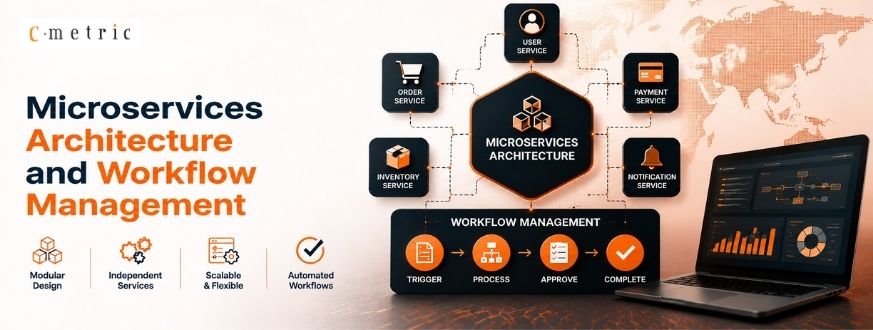
Microservices Architecture and Workflow Management
UNDERSTANDING SYSTEM COMPONENTS AND CUSTOM INTERVAL PROCESSES
1. What are Microservices Architecture?
In a pure Microservices Architecture setup, a large software application is broken down into small, separate mini-programs called services. Each service does only one specific job and runs completely on its own computer process, using its own isolated database tables.
What are Microservices – A modern Microservices Architecture approach that builds applications using small, independent services for better scalability, flexibility, and faster development.
The Good Parts (Pros)
- Easy Scaling: If one specific action gets very busy, you can grow just that service without touching the rest of the application.
- Isolated Mistakes: If a bug crashes one background component, your main data worker keeps running. The error stays trapped in one place.
- Independent Changes: Development teams can update one service without rebuilding or redeploying the other programs.
The Bad Parts (Cons)
- Network Slowdowns: Because the services are separate, they have to talk over network connections. This adds latency and slows things down compared to running inside a single program’s memory.
- Uncertain States: If one service updates its database, but a network error disconnects the next service halfway through the task, your data becomes split and broken.
- High Complexity: Managing multiple separate mini-programs means managing multiple server configurations and deployment pipelines.
2. Workflow Management & Shared System Timer
The entire five-service system is synchronized by a single, easy-to-change Master Settings Clock that wakes up every service simultaneously based on a pre-set time interval (like every 5 minutes or 30 seconds).
Monolithic vs Microservices – A comparison of traditional single-unit applications and modern service-based architecture for scalability, flexibility, and efficient development.
Once that master clock ticks, the workflow management handles the tasks using two distinct coordination strategies:
Service 1: The Core Engine Assembly Line
- What Wakes It Up: The Master Settings Clock.
- How It Works Internally (The Assembly Line Rule): Think of Service 1 as an ultra-secure automated factory assembly line. It manages a chain of tightly connected sub-tasks that must happen in a flawless order. There are no separate timers inside this service. Instead, it follows a strict dependency rule: Sub-
Task B cannot start until Sub-Task A is perfectly finished, and Sub-Task C must wait on Sub-Task
- It passes data instantly from one step to the next within its own internal computer memory at lightning speed.
- Why It Is Built This Way (Absolute Data Safety): This structure acts as an automatic safety brake for your business records. If a piece of corrupted data or an unexpected error occurs halfway through processing (for example, at Sub-Task C), the entire assembly line freezes instantly. Because it halts immediately, it guarantees that bad or broken information never reaches the final step and is never saved to your shared database. It completely eliminates the risk of broken data leaking into the rest of your system.
Services 2 to 5: The Independent Delivery Drivers & Alerts
- What Wakes Them Up: The Master Settings Clock.
- How It Works Internally (The Digital Bulletin Board): Services 2 through 5 (such as your reconciliation tools, file transmitters, and email alert engines) wake up on the exact same master alarm as Service 1. However, they do not talk to Service 1 directly, and they don’t wait for a direct command. Instead, they act like a team of independent delivery drivers. They walk into the warehouse and check a Shared Digital
Bulletin Board (the shared storage database). They look specifically for a “Ready for Delivery” flag or status update that Service 1 leaves behind only when its assembly line finishes successfully.
- Why It Is Built This Way (Total Speed & Isolation): This design keeps your core business operations entirely insulated from external real-world delays. If a third-party email server slows down or a network connection drops while Service 2 is trying to send a notification, that failure is completely sandboxed. Service 2 can retry or wait in its own lane without affecting anything else. It will never stall, freeze, or delay Service 1 from starting its next core assembly line on time the very next time the master clock ticks.
SYSTEM WORKFLOW BLUEPRINT DIAGRAM
┌──────────────────────────────────┐
│ MASTER CONFIGURATION CLOCK │
│ (e.g., Goes off Every 5 Minutes) │
└────────────────┬─────────────────┘
│
┌─────────────────────────┴─────────────────────────┐
▼ (Simultaneous Wakeup) ▼ (Simultaneous Wakeup)
┌──────────────────────────────────────┐ ┌──────────────────────────────────────┐
│ SERVICE 1 (Core Assembly Line) │ │ SERVICES 2 TO 5 (Delivery Drivers) │
│ Starts its internal team tasks │ │ Work independently in parallel │
└──────────────────┬───────────────────┘ └──────────────────┬───────────────────┘
│ │
▼ (Dependency Pipeline) │
┌────────────────────────────────────┐ │
│ Sub-Task A: Prep & Clean Workspace │ │
└─────────────────┬──────────────────┘ │
▼ (Wait for Completion) │
┌────────────────────────────────────┐ │
│ Sub-Task B: Read Incoming Files │ │
└─────────────────┬──────────────────┘ │
▼ (Wait for Completion) │
┌────────────────────────────────────┐ │
│ Sub-Task C: Check Data for Errors │ │
└─────────────────┬──────────────────┘ │
▼ (Wait for Completion) │
┌────────────────────────────────────┐ │
│ Sub-Task D: Save & Leave Ready Flag│ │
└─────────────────┬──────────────────┘ │
│ │
└───────────────┐ ┌───────────────┘
│ │
▼ ▼
┌─────────────────────────────┐
│ SHARED DIGITAL BULLETIN │
│ (Shared Storage Database) │
└─────────────────────────────┘
3. Conclusion
By uniting all 5 Microservices Architecture under a single synchronized time interval while running tightly coupled tasks one-by-one via dependency-driven process threads in Service 1, you build an extraordinarily reliable workflow. This design layout pairs the massive speed advantages and transaction tracking safety of in-memory application threading with the independent horizontal scaling capabilities of a Microservices Architecture blueprint.