
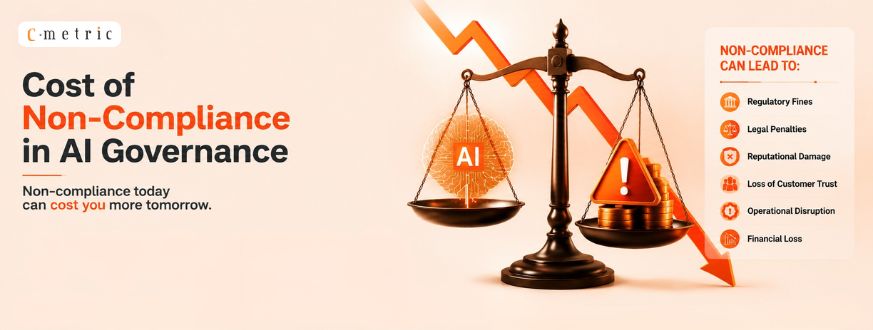
Cost of Non Compliance in AI Governance
AI Governance often takes a backseat as a regulatory requirement for many enterprises. Little do they know that governance may become far more expensive when deployed late.
Artificial intelligence is undoubtedly transforming businesses. It improves efficiency and data-driven decision-making for organizations by automating operations to a great extent. However, with increased usage of AI, the need for robust governance frameworks has also increased. That’s the best way to ensure that your operations are transparent, secure, and ethical.
The true cost of non-compliance in AI governance is not limited to fines. It includes remediation expenses, reputational damage, reduced AI adoption, and missed business opportunities. Organizations working with a top-notch Custom Software Development Company often discover that governance is most effective when integrated into the development process rather than added after deployment.
Understanding AI Governance Compliance
What is AI Compliance?
AI compliance can be considered a set of policies, controls, and processes. Its purpose is to ensure that AI systems adhere to applicable laws (regional or otherwise), regulations, ethical standards, and organizational policies.
AI Governance is a way to implement safeguards that promote accountability and privacy throughout the AI lifecycle. Strong AI governance compliance practices help organizations identify potential issues before they become business problems. They also help businesses demonstrate responsible AI usage to customers, regulators, and investors.
Key Principles of AI Governance and Compliance
Effective AI governance relies on a set of principles, such as:
- Transparent decision-making using AI
- Protecting data’s privacy and keeping it safe
- Mitigating bias and ensuring fairness
- Accountability and oversight
- Risk management and monitoring
- Regulatory adherence
Together, these principles form the foundation of AI governance and compliance programs that support both innovation and risk management.
The Role of Developers and Organizations
Gone are those days when compliance used to be the responsibility of legal or risk teams only. In the AI era, developers, data scientists, executives, and compliance professionals all contribute to the governance process. Together, they make decisions that influence how AI systems are designed, used, and maintained.
The above invokes a sense of shared responsibilities. However, if the roles are unclear, the likelihood of non-compliance in AI governance increases significantly. To ensure AI systems operate as intended and align with organizational objectives, three things must be taken care of:
- Clear ownership
- Documentation of processes
- Established accountability mechanisms
Risks and Consequences of Non-Compliance
Financial Implications
In many cases, non-compliance in AI governance requires businesses to redesign AI systems, retrain models, and implement corrective controls.
While there surely are costs involved in becoming compliant, the cost of failing at AI governance is even higher. It includes:
- Regulatory fines and penalties
- Litigation expenses
- Increased audit costs
- Operational disruptions
- Remediation and redevelopment expenses
Legal and Regulatory Risks
As requirements evolve and AI usage increases, organizations face greater scrutiny regarding how models are trained, monitored, and used. These growing expectations represent one of the most significant AI governance challenges facing organizations today.
Governments, globally, are also introducing regulations to ensure accountability for AI systems. Failing to comply can trigger investigations, lawsuits, and legal actions, resulting in losses and public criticism.
Operational and Ethical Risks
Not all governance failures result in regulatory penalties.
Poorly governed AI systems may generate inaccurate outputs or expose sensitive information. They may even amplify bias or make decisions that conflict with organizational values.
These issues can reduce user confidence and limit adoption.
Standardized AI governance compliance practices help enterprises establish more effective mechanisms that improve system reliability and support ethical decision-making.
Tools and Best Practices for Compliance
AI Compliance Software Solutions
Using off-the-shelf or customized software solutions can simplify compliance management. With these solutions, it is possible to automate monitoring, auditing, and generate the required reports. Using these solutions doesn’t just increase an organization’s visibility into AI operations but also reduces the burden of taking care of compliance manually.
Modern AI compliance software solutions often provide:
- Risk assessment dashboards
- Policy enforcement tools
- Model monitoring systems
- Audit trail generation
- Regulatory reporting support
- Bias detection capabilities
Implementing Governance Controls
Enterprises can expect better results when governance is integrated into the AI lifecycle rather than performed as a separate activity. To achieve this, Artificial Intelligence teams can establish governance checkpoints at every stage of development.
The steps to help reduce the likelihood of non-compliance in AI governance are:
- Defining governance policies
- Conducting risk assessments
- Establishing approval workflows
- Monitoring model performance
- Reviewing compliance requirements regularly
Remember, preventing non-compliance in AI governance is usually less expensive than fixing things later. Organizations that delay governance often face greater implementation costs later.
Training and Documentation
Compliance depends on people as much as technology. That’s the reason why comprehensive proper training and documentation strengthen AI governance and compliance efforts.
Real-World Examples and Case Studies
Consequences of Non-Compliance
Non-compliance in AI governance failures can:
- Reduce AI adoption
- Limit an organization’s ability to scale AI initiatives
- Lower ROI
- Increase system failures
Real-world examples include an AI recruiting tool that was discontinued after it was found to reinforce gender bias and loan-approval algorithms, leading to legal as well as reputational concerns.
Successful Compliance Practices
An APAC bank implemented an AI-powered compliance and risk management system. The newly-deployed solution delivered $1 million in annual savings and cut resolution time by 40%, showing how governance can improve both compliance and operational performance.
The above example proves that businesses that leverage technologies such as AI-Powered Virtual Assistants while maintaining strong governance controls demonstrate that innovation and accountability can coexist.
Lessons Learned for Developers and Organizations
Several lessons consistently emerge from successful governance programs. A few of them are:
- Establish governance responsibilities early
- Conduct regular risk assessments
- Monitor AI systems continuously
- Maintain detailed documentation
- Prioritize transparency and accountability
Addressing these common AI governance challenges before deployment can significantly reduce future risks and costs.
Future Outlook
Emerging Regulations and Standards
AI compliance & governance is moving from a recommended practice to a business requirement.
Governments worldwide are introducing new regulations aimed at increasing accountability, transparency, and oversight for AI systems. The European Union has taken a leading role through the EU AI Act, which can impose penalties of up to €35 million or 7% of global annual turnover for serious violations. These penalties demonstrate how regulatory bodies increasingly view AI governance as a critical business responsibility.
Preparing for Proactive Compliance
Research from McKinsey shows that 88% of organizations use AI in at least one business function. However, only 22% report having robust governance frameworks in place. This imbalance creates significant exposure, especially at a time when AI systems become more deeply integrated into daily operations.
Organizations can strengthen their compliance posture by prioritizing:
- Continuous monitoring and audits
- Alignment with international compliance standards
Conclusion
AI systems encourage innovation and growth. They have the ability to create tremendous opportunities. However, not when governance practices are ignored or treated as an afterthought.
The costs related to non-compliance in AI governance do not stop at penalties and legal issues. Operational setbacks and reduced trust are two major disadvantages that businesses don’t realize early.
Strong governance frameworks help organizations reduce risk and improve accountability related to AI-driven decisions. In an increasingly regulated environment, investing in governance today is often far less costly than addressing the consequences of non-compliance tomorrow.