
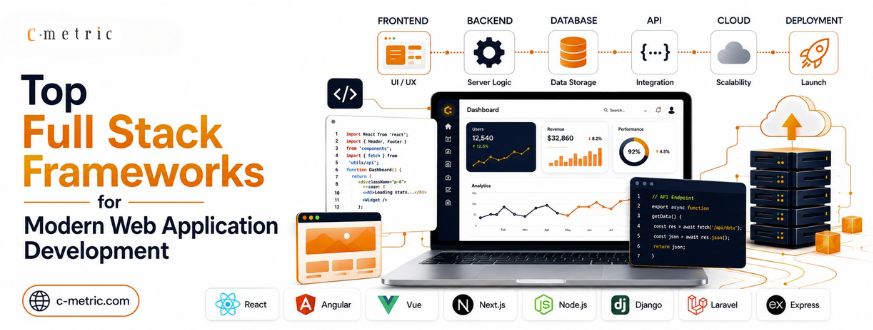
Top Full Stack Frameworks for Modern Web Application Development
Demand for scalable, high-performance web applications has reached an all-time high in 2026. Businesses across every industry need platforms that are fast to build, easy to maintain, and ready to grow. Full stack frameworks for modern web application development make this possible by combining frontend and backend development into one cohesive technology layer. Choosing the right framework is a critical decision one that shapes your development speed, long-term scalability, and competitive positioning. C-Metric helps businesses navigate this choice with tailored technology consulting and end-to-end application development.
What Are Full Stack Frameworks?
Full stack frameworks are development platforms that handle both the frontend what users see and interact with and the backend, the server, database, and business logic within a unified structure. Instead of assembling separate technologies for each layer, developers work within a single, cohesive ecosystem that accelerates development and reduces architectural complexity.
Understanding what is a full stack website helps clarify this further. A full stack website is built using technologies that manage the complete user experience on the frontend while simultaneously handling data processing, authentication, and server communication on the backend. The result is a connected, fully functional web application delivered through one integrated development approach.
Key Features of Full Stack Development
-
Frontend and backend connectivity
Seamless communication between user interface and server logic
-
Database integration
Built-in support for connecting and querying databases efficiently
-
API management
Structured tools for building and consuming APIs across services
-
Security support
Authentication, authorization, and data protection built into the framework layer
Why Businesses Prefer Full Stack Solutions
-
Faster deployment
Unified frameworks reduce the coordination overhead between frontend and backend teams
-
Better scalability
Architecture designed to handle growing users, data, and features from the start
-
Reduced development complexity
Fewer context switches and integration challenges across the stack
Why Full Stack Frameworks Are Important in 2026
The volume and complexity of modern web applications have grown dramatically. Businesses need to ship products faster, adapt to user feedback in real time, and support thousands of concurrent users without performance degradation. Modern full stack frameworks are designed to meet exactly these demands, making them a cornerstone of digital transformation strategies in 2026.
The organizations that move quickly and reliably are the ones investing in the right technology stack from the beginning. A well-chosen framework does not just accelerate initial development, it reduces the cost of future changes and ensures long-term maintainability.
Business Benefits of Modern Full Stack Frameworks
-
Faster development cycles
Pre-built components, libraries, and conventions shorten time to market
-
Cost-effective architecture
Unified stacks reduce the need for large, siloed development teams
-
Improved user experience
Consistent, performant interfaces built with modern frontend capabilities
Additional advantages include:
- Simplified maintenance through standardized code patterns and documentation
- Better performance from frameworks optimized for speed and efficient resource use
- Easier scalability as the application grows in users, features, and data complexity
Best Full Stack Frameworks for Modern Web Development
Choosing from the best full stack frameworks requires understanding your project’s specific requirements, traffic expectations, team expertise, integration needs, and long-term support availability. Here is an overview of the frameworks leading modern web development in 2026.
MERN Stack
The MERN Stack- MongoDB, Express.js, React, and Node.js is one of the most widely adopted full stack combinations for scalable web applications. Its JavaScript-first approach means the same language runs on both frontend and backend, reducing context switching and enabling faster iteration. It is particularly well-suited for real-time applications, social platforms, and SaaS products. Explore our detailed breakdown of Full Stack Combinations to understand how MERN compares against other popular pairings.
Django Stack
Django is a Python-based full stack framework built around the principle of rapid, secure development. Its batteries-included philosophy means authentication, ORM, admin panels, and security protections come standard. Django is a strong choice for data-heavy applications, machine learning integrations, and platforms where security and compliance are top priorities.
Laravel Stack
Laravel is a PHP framework designed for building robust, enterprise-grade applications with clean, expressive syntax. Its ecosystem includes tools for authentication, queuing, caching, and API development, making it a reliable choice for businesses that need a mature backend framework with strong community support and long-term stability.
Ruby on Rails
Ruby on Rails remains a strong choice for teams that prioritize rapid development and convention over configuration. It is especially popular in startup environments where getting to market quickly is as important as technical elegance. Rails’ opinionated structure allows small teams to build and ship full-featured applications in a fraction of the time.
Choosing the Right Framework
Three factors should guide every framework decision:
- Performance Requirements
How many users and data transactions must the application support at peak load?
- Scalability Needs
Will the application need to grow significantly in the next one to three years?
- Team expertise
Which languages and ecosystems does your development team already know well?
Full Stack Framework Comparison
A thorough full stack framework comparison goes beyond feature lists. It examines how each framework performs under real-world conditions, how actively it is maintained, and how well it fits with your team’s existing capabilities.
Performance Comparison
MERN and Node.js-based stacks excel in handling high volumes of concurrent requests due to their non-blocking, event-driven architecture. Django delivers strong performance for data processing tasks. Laravel and Rails offer solid throughput for standard enterprise workloads, with performance scaling well through caching and queue management.
Security and Maintenance
Django leads on built-in security, offering protection against SQL injection, cross-site scripting, and CSRF attacks out of the box. Laravel provides robust security tools with a strong track record in enterprise environments. MERN stacks require more deliberate security implementation but offer greater flexibility. Rails benefits from a large, active community that responds quickly to vulnerabilities.
Additional comparison factors include:
-
Development flexibility
How easily can the framework adapt to custom requirements?
-
Community support
Is the ecosystem active, well-documented, and regularly updated?
-
Integration capabilities
How smoothly does the framework connect with third-party APIs and cloud services?
Best Web Frameworks for Startups
For startups, time and budget are the two most constrained resources. The best web frameworks for startups balance rapid initial development with the architectural foundations needed to scale once traction takes hold. Choosing a framework that is fast to prototype but difficult to scale leads to expensive rewrites at the worst possible time.
Startup-Friendly Framework Features
- Low development cost
Conventional patterns and reusable components reduce billable hours
- Quick MVP launch
Opinionated structures accelerate early-stage product delivery
- Scalable architecture
Foundations that support growth without requiring a full rebuild
Why Startups Choose Full Stack Solutions
- Faster product launches that allow early customer validation and iteration
- Easier updates as product requirements evolve based on real user feedback
- Better customer experience through consistent, performant interfaces from day one
Role of Full Stack Developers in Modern Projects
A skilled full stack developer bridges the gap between user-facing design and server-side logic, managing frontend interfaces, backend APIs, database architecture, and cloud integrations within a single role. In agile development environments, this versatility dramatically reduces handoff delays and communication overhead between specialized teams.
Full stack developers are especially valuable in early-stage products and fast-moving projects where flexibility and speed matter more than rigid specialization.
Skills Needed for Full Stack Development
- Frontend technologies
HTML, CSS, JavaScript, and modern frameworks like React or Vue
- Backend frameworks
Node.js, Django, Laravel, or Rails depending on the stack
- Cloud integration
Deploying and managing applications on AWS, Azure, or Google Cloud
- Database management
Working with both relational databases and NoSQL solutions
How C-Metric Helps Businesses Choose the Right Framework
Technology decisions have long-term consequences. C-Metric’s full stack application development team brings deep expertise in modern full stack frameworks by helping businesses evaluate options, select the right architecture, and execute development with precision. Whether you are building a new product from scratch or modernizing an existing platform, C-Metric designs scalable, secure solutions aligned with your business goals.
C-Metric’s Development Approach
- Requirement analysis
Understand your product goals, user needs, and technical constraints
- Framework selection
Recommend the best-fit stack based on performance, budget, and team capabilities
- Development and deployment
Build, test, and launch with quality and speed
- Performance optimization
Continuously improve speed, reliability, and scalability post-launch
C-Metric delivers:
- Scalable solutions designed to support your growth for years ahead
- Secure architecture with best practices built into every development layer
- Long-term support to keep your application performing at its best
FAQs
Which are the best full stack frameworks in 2026?
MERN Stack, Django, Laravel, and Ruby on Rails are among the top choices for modern web application development. The best option depends on your project type, performance requirements, team expertise, and scalability goals.
Why are full stack frameworks popular for startups?
Full stack frameworks offer startups faster development cycles, lower initial costs, and scalable architecture that supports growth without expensive rebuilds. They allow small teams to build and ship full-featured products quickly, a critical advantage during early-stage product development.
Conclusion
Full stack frameworks are the foundation of modern web application development in 2026. They enable faster deployment, reduce architectural complexity, and provide the scalability businesses need to grow without constant rebuilds. Whether you are a startup launching your first product or an enterprise modernizing a legacy platform, choosing the right framework sets the trajectory for everything that follows. C-Metric helps organizations make that decision with confidence by selecting, building, and optimizing full stack solutions designed for long-term success.
Ready to build with the right technology? Get in touch with us at C-Metric is here to help you design and deliver modern web applications that scale.