
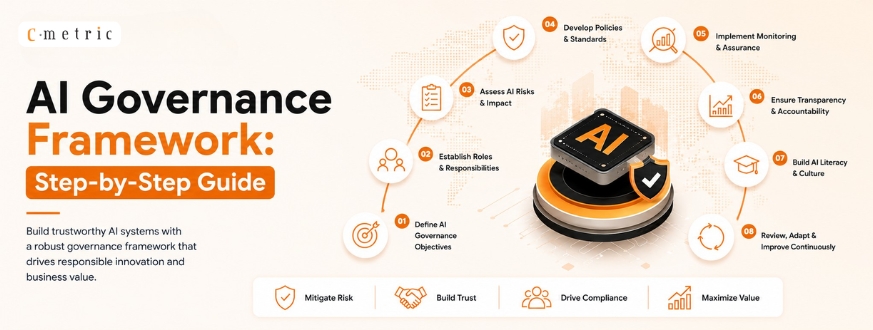
AI Governance Framework: Step-by-Step Guide
We all know that Artificial Intelligence is transforming how businesses operate, make decisions, and serve customers nowadays. But with that power comes greater responsibility. Without a structured AI Governance Framework, organizations risk deploying AI systems that are biased, non-compliant, or harmful that can expose themselves to regulatory penalties, reputational damage, and customer distrust. Building governance into AI from the ground up is no longer optional; it is a strategic necessity. As a prominent Custom Software Development Company, C-Metric helps organizations design and implement governance-first AI systems that are ethical, secure, and built for long-term accountability.
Why AI Governance Matters?
Understanding AI Risks and Compliance Needs
What is AI governance? At its core, AI governance is the set of policies, processes, and accountability structures that ensure AI systems operate safely, transparently, and in alignment with legal and ethical standards. As AI adoption accelerates across healthcare, finance, retail, and government, the absence of governance creates serious risks from biased automated decisions to violations of data privacy laws.
AI governance and ethics cannot be separated. Ethical AI is not simply about building systems that work, it is about ensuring they work fairly, transparently, and without causing harm to individuals or communities. Organizations that fail to address these dimensions’ risk both legal exposure and the erosion of public trust in their technology.
The Role of Data and Model Accountability
A strong AI Governance Framework establishes clear accountability for how data is collected, processed, and used to train AI models. This includes maintaining audit trails for training datasets, documenting model decisions, and ensuring that AI outputs can be explained to regulators, auditors, and affected users.
Model accountability means that every AI-generated decision has a traceable owner- a team, a process, and a policy responsible for its outcome. Without this, organizations cannot effectively investigate errors, respond to complaints, or demonstrate compliance during regulatory reviews.
Impact on Business and Innovation
Governance is not a barrier to innovation, it is an enabler of it. AI governance compliance reduces the legal and ethical risks that slow down or halt AI projects mid-deployment. Organizations with mature governance frameworks are better positioned to scale AI responsibly, attract enterprise customers with compliance requirements, and build products that regulators and users trust. In the long run, governed AI moves faster because it avoids the costly setbacks of ungoverned systems.
Key Elements of a Robust AI Governance Framework
Policy and Ethical Guidelines
The foundation of any effective artificial intelligence governance framework is a comprehensive set of policies that define how AI systems should be designed, deployed, and monitored. These policies must address ethical considerations at every stage of the AI lifecycle from data sourcing to model retirement.
Core policy elements include:
-
Clear decision-making protocols
Define who approves AI models and under what conditions they can be deployed
-
Data protection measures
Ensure personal and sensitive data is handled in compliance with GDPR, HIPAA, and other applicable regulations
-
Bias detection and mitigation
Establish processes to identify, measure, and correct bias in training data and model outputs. Without these policy foundations, governance remains theoretical rather than operational.
Tools and Technology Support
Implementing governance at scale requires dedicated ai governance software, platforms designed to monitor AI model behavior, track compliance metrics, and surface anomalies before they become incidents. These tools provide the visibility that compliance teams and auditors need to verify that AI systems are operating within defined boundaries.
A well-implemented artificial intelligence governance framework integrates software tools across the full AI pipeline from data ingestion through model training, deployment, and ongoing performance monitoring. Automation reduces the manual burden on teams while improving consistency and audit readiness.
Integrating Governance into AI Lifecycle
Governance cannot be retrofitted at the end of development; it must be embedded at every stage. An effective AI Governance Framework begins at the planning phase, with ethical impact assessments and regulatory mapping, and continues through design, development, deployment, and post-launch monitoring. The earlier governance is integrated, the lower the cost and complexity of maintaining it.
Step-by-Step Implementation Process
Phase 1 – Assessment and Planning
Every successful governance implementation begins with a clear-eyed assessment of the current state. Organizations must evaluate existing AI systems, identify governance gaps, and map the regulatory requirements that apply to their industry and geography. Selecting appropriate ai governance models whether principle-based, rule-based, or hybrid is a critical planning decision that shapes the entire framework.
Key activities in this phase include:
-
Stakeholder mapping
Identify who owns, operates, and is affected by each AI system
-
Regulatory analysis
Review applicable laws, industry standards, and voluntary frameworks such as the NIST AI Risk Management Framework
-
Ethical considerations
Assess potential harms, fairness risks, and transparency obligations for each AI use case
Phase 2 – Deployment and Monitoring
With policies defined and models selected, the focus shifts to operationalizing governance across the organization. It means embedding compliance checkpoints into development workflows, deploying monitoring tools that track model performance and drift, and establishing escalation paths for when AI systems behave unexpectedly.
C-Metric’s Artificial Intelligence services include governance-aligned AI deployment, ensuring that monitoring, logging, and alerting systems are active from the first day of production. Continuous monitoring is not a post-launch addition; it is a core operational requirement for responsible AI.
Phase 3 – Continuous Improvement
AI governance is not a one-time implementation; it is an ongoing discipline. As AI models evolve, regulations change, and business contexts shift, the AI Governance Framework must adapt accordingly. Regular audits, structured feedback loops, and cross-functional governance reviews ensure that the framework stays current and effective.
The most mature organizations treat governance improvement as a continuous cycle using audit findings to update policies, retrain models, and refine monitoring thresholds. The AI Governance Framework should become stronger and more precise with every iteration.
Practical Examples and Lessons Learned
Success Stories in AI Governance
Organizations that invest in structured governance consistently report better outcomes. Financial institutions that implemented AI governance compliance programs before deploying credit-scoring models avoided regulatory scrutiny and reduced customer complaints about unfair decisions. Healthcare providers that governed their diagnostic AI systems built the clinical trust necessary for broader adoption, demonstrating that governance accelerates rather than limits deployment.
Avoiding Common Pitfalls
The most frequent governance failures share common patterns: governance treated as a compliance checkbox rather than an operational discipline, lack of executive sponsorship, insufficient cross-functional collaboration, and monitoring systems deployed too late in the AI lifecycle. Organizations that want to learn from these failures and understand the broader context of responsible digital transformation can explore Empowering Enterprises with Smart Digital Transformation for practical perspective on how governance fits into a wider modernization strategy.
Takeaways for Developers and Decision-Makers
The most important lesson from organizations that have successfully implemented AI governance is this: start early and make governance everyone’s responsibility. An AI Governance Framework cannot live in a single compliance team; it must be embedded in the culture, tools, and processes of every team that touches AI. For decision-makers, that means investing in governance infrastructure before AI systems reach production. For developers, it means designing systems with explainability, auditability, and fairness as first-class requirements.
Looking Ahead
Future of AI Governance
Regulatory attention on AI is intensifying globally. The EU AI Act, emerging US federal guidelines, and international standards from bodies like ISO and IEEE are reshaping what responsible AI deployment looks like. AI governance models will need to evolve rapidly becoming more adaptive, more automated, and more deeply integrated with development pipelines. Organizations that build governance capabilities now will be far better positioned to meet tomorrow’s regulatory requirements without disruption.
Preparing for Global AI Compliance
As AI regulation becomes cross-border and sector-specific, governance frameworks must be designed for international applicability. Key priorities include:
-
Cross-border compliance
Aligning AI practices with the regulatory requirements of every geography in which AI systems operate
-
Ethical AI deployment
Meeting not just legal minimums but the higher standards that enterprise customers, regulators, and the public increasingly expect
Conclusion
In short, a structured AI Governance Framework is no longer a best practice, it is a business imperative. Understanding what is AI governance is the first step, but implementation is where organizations create real, lasting value. From establishing ethical policies and selecting the right governance models, to deploying monitoring tools and running continuous improvement cycles, governance is the foundation that makes AI trustworthy at scale.
The organizations that govern well are the ones that scale confidently, comply consistently, and build AI systems that stand the test of time. The AI Governance Framework you build today directly determines the quality and credibility of the AI products you deliver tomorrow.
If you are ready to build AI systems that are ethical, compliant, and built to scale then Get in touch with us. C-Metric is here to help you design and implement a governance-first AI strategy with confidence.